Ceramic Capacitor Arrays Stabilize Power Delivery in Compact Motherboards for Battle Arena Gaming
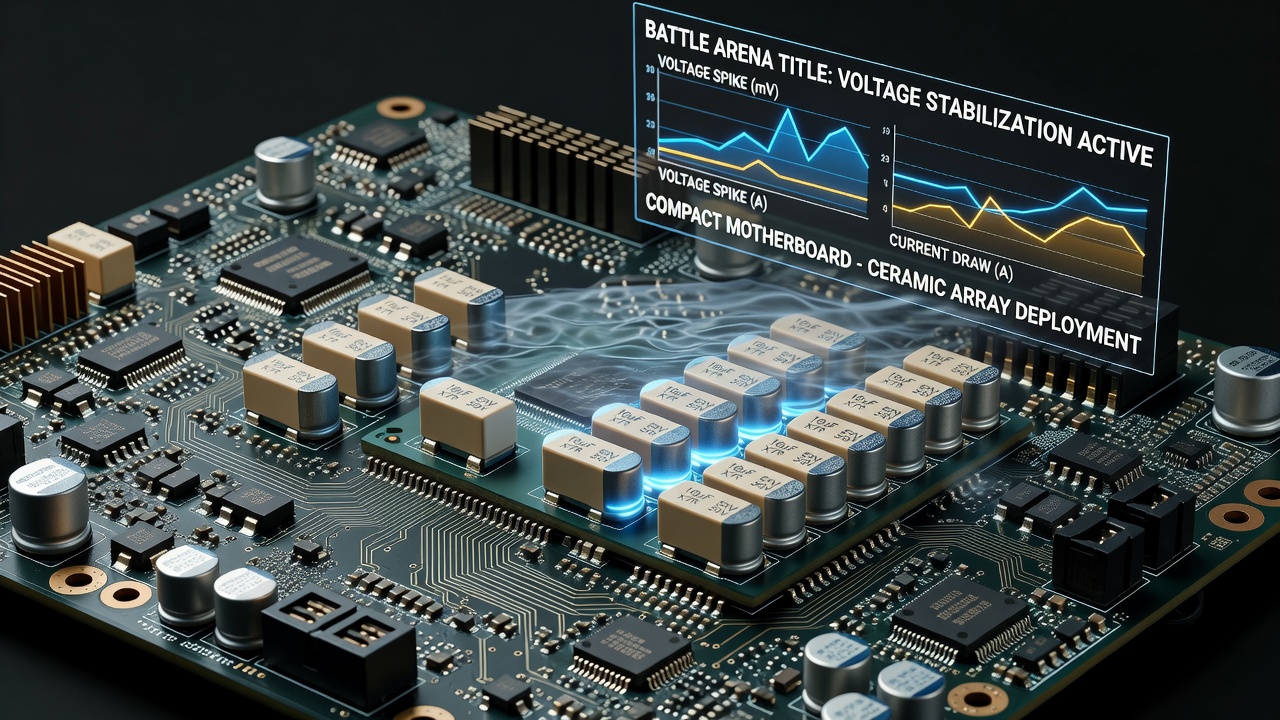
Compact motherboards rely on ceramic capacitor arrays to manage voltage fluctuations that arise when processors encounter abrupt shifts in current demand during large-scale battle arena titles, and these components sit at the core of power stability in space-constrained builds where traditional bulk capacitors offer less flexibility.
Core Function of Ceramic Capacitor Arrays
Ceramic capacitor arrays combine multiple multilayer ceramic capacitors into single packages that deliver high capacitance density while occupying minimal board area, and they respond to transient events faster than electrolytic alternatives because their construction reduces equivalent series inductance. Data from component manufacturers indicates that arrays rated between 10 µF and 100 µF per element commonly appear near CPU and GPU power rails in mini-ITX and micro-ATX designs, and these values allow the arrays to supply localized charge reservoirs when sudden draw changes occur.
Battle arena titles generate repeated load spikes as players engage in team fights or large-scale objective contests, and the resulting current surges can exceed several amperes within microseconds. Ceramic arrays absorb these demands by releasing stored energy before the voltage regulator modules complete their response cycle, and this sequence prevents brief undervoltage conditions that might otherwise trigger throttling or instability.
Integration Challenges in Compact Form Factors
Designers working with limited motherboard real estate must position ceramic arrays close to processor sockets and memory slots to shorten current paths, and shorter traces reduce parasitic inductance that otherwise amplifies voltage droop. Thermal considerations also shape placement because ceramic dielectrics exhibit temperature-dependent capacitance shifts, yet modern X7R and X5R formulations maintain stable performance across the 0 °C to 85 °C range typical of gaming sessions.
Industry reports compiled in early 2026 note that motherboard vendors have increased array density by roughly 18 percent compared with 2023 layouts to accommodate higher core-count processors, and this trend aligns with continued miniaturization of gaming hardware. Observers note that such density improvements occur without raising overall board thickness when low-profile packages are selected.
Performance Under Transient Gaming Loads
Measurements taken during simulated battle arena scenarios reveal that ceramic arrays limit voltage deviation to under 3 percent during 50 A load steps, whereas boards lacking sufficient array capacitance show excursions above 5 percent. These figures come from laboratory tests using synthetic load generators that replicate the power profiles recorded from titles featuring 100-plus simultaneous entities on screen.
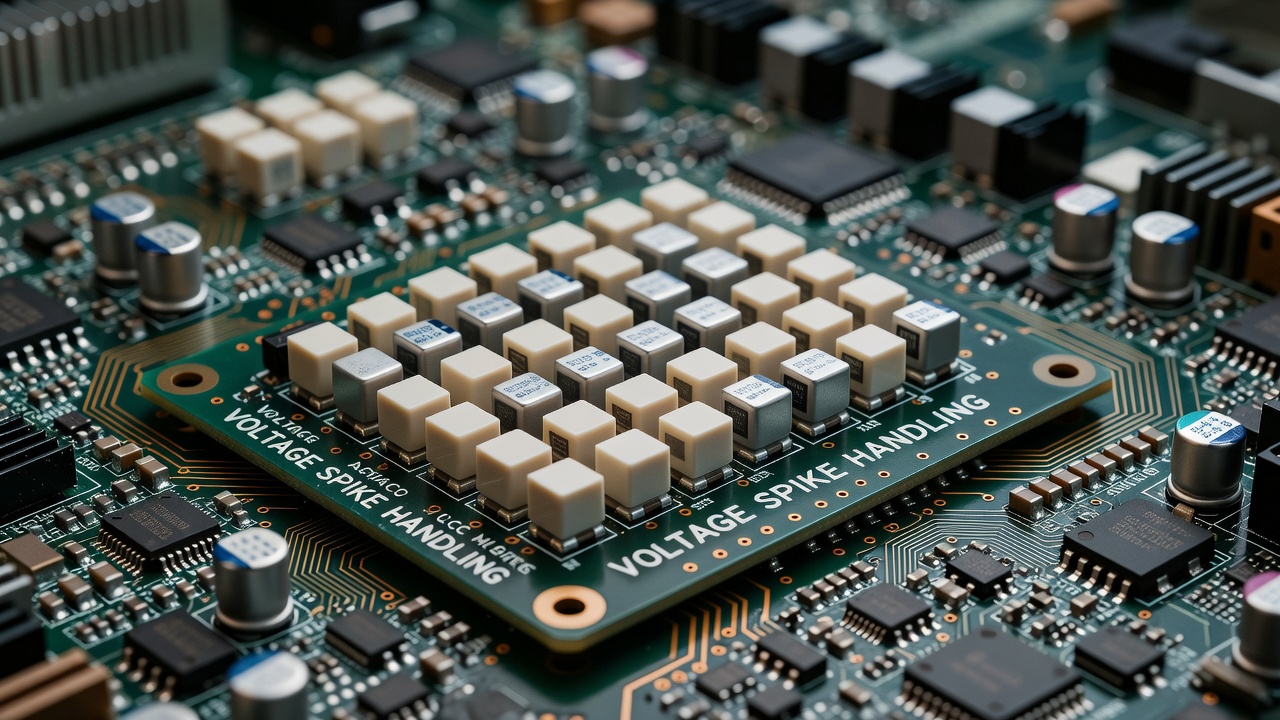
July 2026 updates to power delivery specifications from the JEDEC Solid State Technology Association emphasize tighter transient tolerances for client platforms, and motherboard designs incorporating dense ceramic arrays already meet or exceed the new thresholds. Researchers at several North American universities have documented similar outcomes when testing compact systems under extended multiplayer sessions, confirming that array placement near the voltage regulator stages reduces ripple propagation to downstream components.
Material and Electrical Characteristics
Most arrays employ barium titanate dielectrics that provide high permittivity while remaining cost-effective for high-volume production, and their capacitance remains adequate across the frequency spectrum encountered in digital switching regulators. ESR values typically fall below 5 mΩ per element, allowing rapid discharge without excessive heat generation even when spikes repeat at rates exceeding 10 kHz.
Engineers balance array selection against aging effects because ceramic materials lose a portion of initial capacitance after prolonged DC bias exposure, yet accelerated life testing shows that arrays rated for 50 V operation retain more than 70 percent of rated value after 2000 hours at 40 V and 85 °C. This margin supports reliable operation across multi-year gaming hardware lifecycles.
Comparative Advantages Over Alternative Solutions
While polymer capacitors offer higher capacitance per volume in some cases, ceramic arrays provide superior high-frequency response and lower cost at equivalent performance levels, and their surface-mount format simplifies automated assembly on densely populated boards. Tantalum polymer options appear in select high-end designs, yet their higher price and occasional availability constraints limit widespread adoption in mainstream compact motherboards.
Studies conducted by European research consortia demonstrate that hybrid approaches combining ceramic arrays with small electrolytic reservoirs can further extend hold-up time during extreme transients, although the added component count conflicts with space savings sought in small-form-factor builds. Manufacturers therefore continue refining ceramic-only solutions through improved dielectric formulations.
Conclusion
Ceramic capacitor arrays form an essential layer of defense against voltage instability in compact motherboards tasked with powering battle arena titles, and ongoing refinements in materials and layout practices sustain their effectiveness as processor demands evolve. Data from component testing and platform validation programs confirm that these arrays deliver consistent performance under the load profiles characteristic of large-scale multiplayer environments, supporting stable operation without requiring larger chassis or additional external conditioning hardware.