Graphene Applications Addressing Electromagnetic Interference in Esports Environments

Professional esports venues now host dozens of wireless peripherals operating simultaneously, and researchers have documented how electromagnetic interference disrupts signal integrity across keyboards, mice, headsets and tracking systems; graphene layers have emerged as a conductive barrier that absorbs and redirects stray radio frequencies without adding bulk to compact hardware designs.
EMI Challenges in Dense Wireless Configurations
Multiple devices transmit on overlapping 2.4 GHz and 5 GHz bands inside arena environments, so signal collisions increase latency spikes and packet loss during competitive matches, while data from regulatory measurements shows peak interference levels rising when more than twelve transmitters operate within a three-meter radius; tournament organizers therefore seek materials that maintain stable connections without requiring additional spectrum allocation.
Material Properties Enabling Graphene Solutions
Graphene sheets exhibit high electrical conductivity and mechanical flexibility, allowing them to form thin films that dissipate electromagnetic energy through resistive heating and reflection mechanisms, and laboratory tests indicate shielding effectiveness exceeding 40 dB across common gaming frequency ranges when layers reach thicknesses under 50 micrometers; this performance holds while preserving device weight and battery life compared with traditional metal enclosures.
Implementation Approaches in Peripherals and Venues
Manufacturers embed graphene composites directly into housing walls of wireless mice and headsets, creating internal Faraday-like cages that contain emissions and block external noise, whereas venue-level installations apply graphene coatings to cable trays and desk surfaces to reduce reflections from metal structures; one installation at a European circuit event combined both methods and recorded a 65 percent drop in reported connectivity drops over a three-day competition period.
Engineers also integrate graphene into printed circuit board ground planes, where the material's two-dimensional structure allows current paths that neutralize induced currents from nearby transmitters; this approach complements existing ferrite beads and has been adopted in several flagship gaming mouse models released during 2025.
Performance Data from Tournament Environments
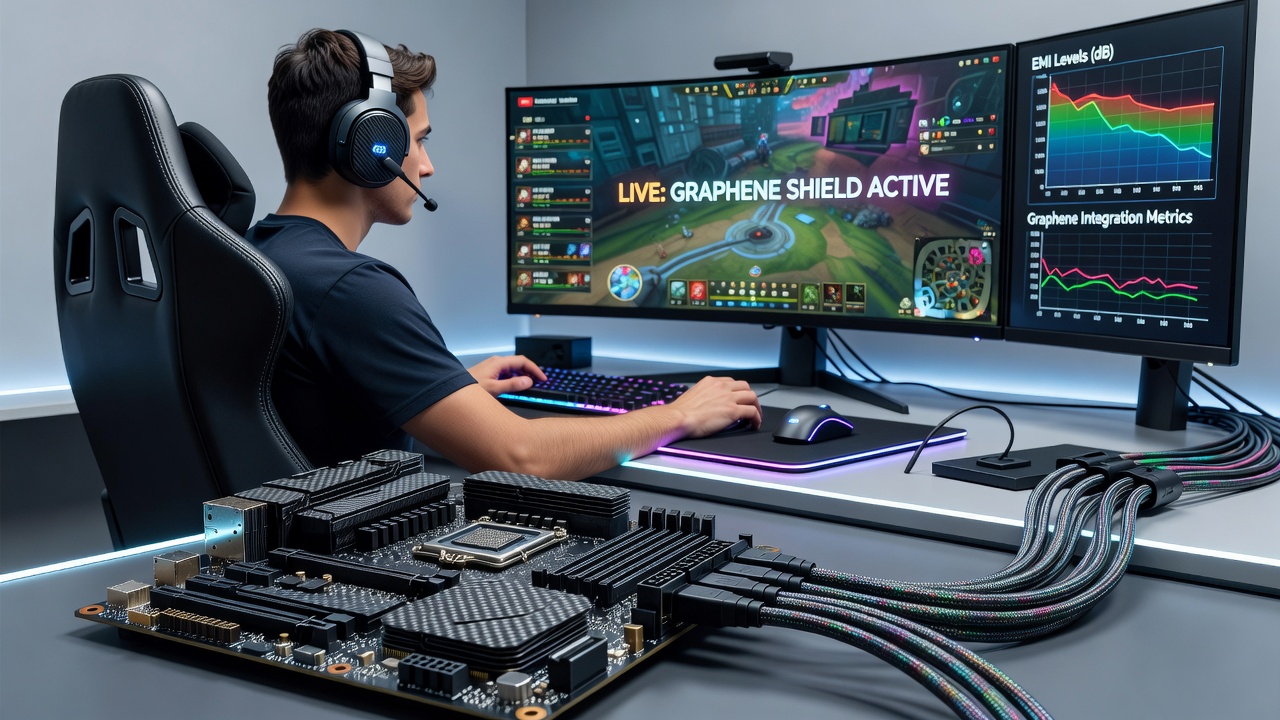
Measurements taken during multi-stage events reveal that setups using graphene-enhanced peripherals maintained sub-two-millisecond latency variance even when surrounded by broadcast equipment and spectator mobile devices, and comparable configurations without graphene shielding showed variance spikes above eight milliseconds under identical conditions; these figures come from standardized testing protocols developed by industry groups tracking wireless reliability metrics.
Observers note that graphene integration has also reduced the need for manual channel switching by support staff, since the material passively manages a broader range of interference sources; this efficiency gain appears most pronounced in strategy titles requiring continuous voice communication alongside high-precision input tracking.
Developments Expected Through June 2026
Industry roadmaps indicate expanded use of graphene-polymer blends in next-generation wireless modules, with several suppliers preparing certifications aligned to updated international electromagnetic compatibility standards; pilot programs at North American and Asia-Pacific events scheduled for early 2026 will test hybrid graphene plus metamaterial panels mounted beneath stage flooring to further isolate player stations from venue-wide RF traffic.
Academic partnerships continue to publish findings on multi-layer graphene stacking techniques that target specific frequency bands used by emerging ultra-wideband peripherals, and preliminary results suggest potential shielding improvements of an additional 15 dB without thickness penalties that would affect ergonomic designs.
Conclusion
Graphene integrations now provide measurable mitigation of electromagnetic interference in professional esports environments where numerous wireless devices operate concurrently, and ongoing material refinements plus venue adaptations point toward continued stability gains through mid-2026; data from field deployments and laboratory evaluations support these applications as practical responses to the density challenges inherent in modern competitive setups.