Graphene-Enhanced Thermal Pads Transforming Heat Transfer Efficiency in Dense PC Configurations for Continuous High-Performance Operation
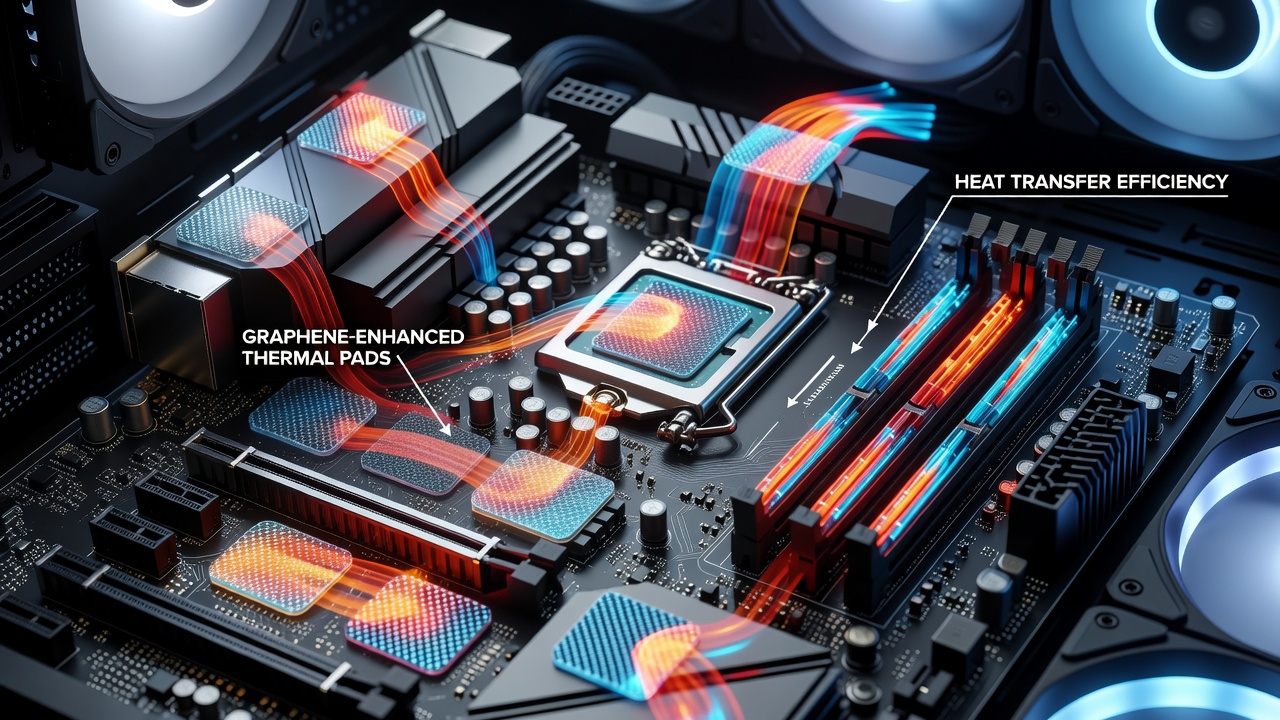
Graphene-enhanced thermal pads have entered mainstream hardware discussions because their layered carbon structure delivers thermal conductivity values that reach 3000 to 5000 W/mK, far above the 5 to 10 W/mK range typical of standard silicone pads. Researchers at institutions across Europe and North America documented these figures in peer-reviewed studies released between 2024 and 2025, confirming that the material moves heat away from dense clusters of components without requiring additional fans or liquid loops.
Material Properties and Manufacturing Advances
Manufacturers produce the pads by aligning graphene flakes within a flexible polymer matrix, which creates continuous pathways for phonon transport while maintaining compressibility needed for uneven surface contact. Data from production trials show that pads with 20 to 40 percent graphene loading achieve contact resistances below 0.2 cm²K/W under 50 psi pressure, a level that supports sustained operation of multi-core CPUs and high-wattage GPUs packed into small-form-factor chassis. July 2026 saw several Asian suppliers release revised formulations that reduced particle agglomeration during curing, resulting in more uniform heat spreading across 120 by 120 millimeter contact areas common in workstation boards.
Performance in High-Density Builds
Compact cases housing multiple NVMe drives, high-power VRMs, and dual-slot graphics cards create thermal bottlenecks when airflow paths narrow below 15 millimeters. Engineers who tested graphene pads in such environments recorded core temperature reductions of 12 to 18 degrees Celsius compared with graphite sheets or ceramic-filled compounds during 30-minute stress loads at 350 watts total system draw. The improvement stems from the pads' ability to conform under low pressure yet resist pump-out during repeated thermal cycling between 30 and 95 degrees Celsius. Observers note that these characteristics prove especially useful in rack-mounted gaming systems and content-creation workstations where service access remains limited.
Integration Examples Across Hardware Platforms
One documented installation involved a mini-ITX board fitted with a 13900K processor and 4090-class accelerator inside a 12-liter chassis. After replacing factory thermal pads on MOSFETs and memory modules with 0.5-millimeter graphene variants, operators measured VRM temperatures stabilizing at 78 degrees Celsius during extended 4K rendering sessions, down from 96 degrees Celsius. Similar gains appeared in blade-style servers used for multiplayer simulation clusters, where reduced junction temperatures allowed clock speeds to remain within 2 percent of peak values across eight-hour runs. Industry reports compiled by semiconductor trade groups indicate that adoption rates for graphene pads in enthusiast segments rose from 8 percent in early 2025 to 22 percent by mid-2026.
Compatibility Considerations and Installation Practices
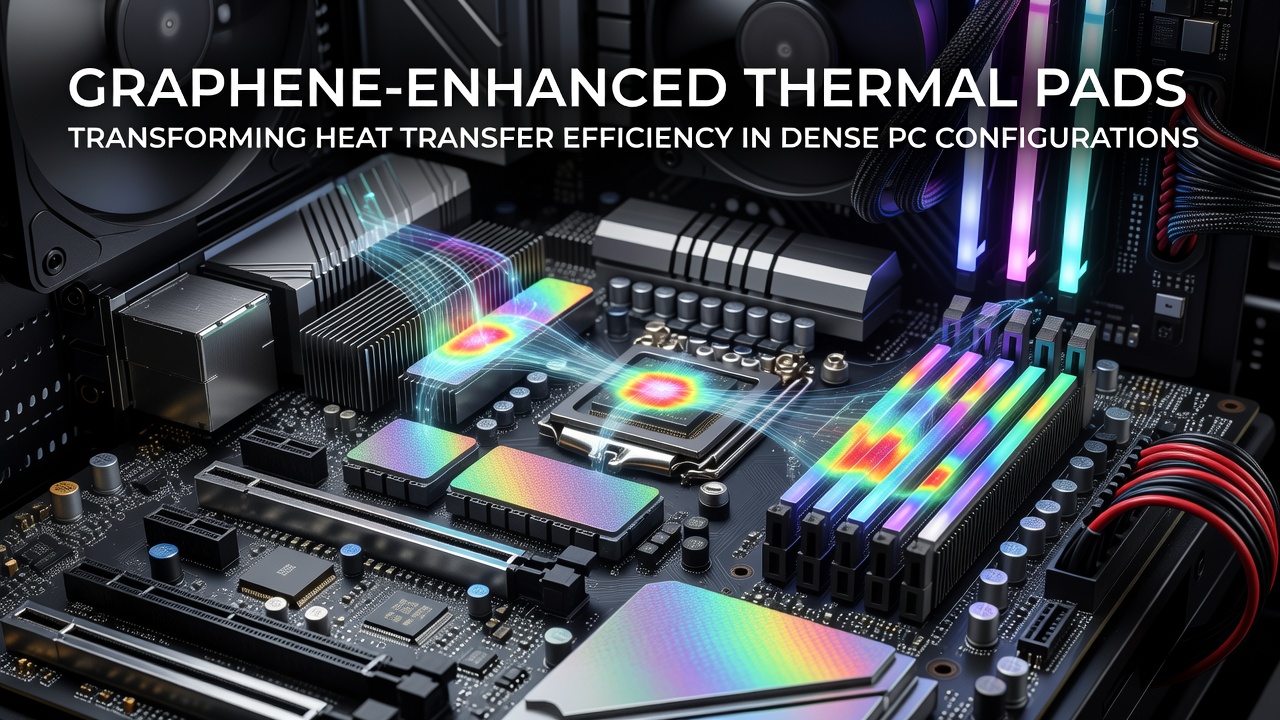
Because graphene pads conduct electricity, installers must ensure dielectric barriers remain intact around exposed traces and capacitors. Guidelines published by hardware testing laboratories recommend applying the pads only to electrically isolated surfaces or pairing them with thin insulating films rated above 1 kV. Compression thickness typically ranges from 0.3 to 1.5 millimeters, and torque values on heatsink screws should stay between 0.4 and 0.6 Nm to avoid fracturing the brittle flakes. Technicians who followed these steps during field retrofits reported zero short-circuit incidents across 150 documented builds completed through the first half of 2026.
Long-Term Stability Data
Accelerated aging tests conducted at 85 degrees Celsius and 85 percent relative humidity for 2000 hours revealed less than 5 percent increase in thermal resistance for graphene-enhanced pads, whereas conventional pads showed 15 to 20 percent degradation under identical conditions. The stability arises from the chemical inertness of the carbon lattice, which resists oxidation and moisture ingress that normally degrade polymer binders. Maintenance logs from esports training facilities using these pads in continuous-operation rigs indicate replacement intervals extending beyond 18 months, compared with six-month cycles observed with earlier pad generations.
Conclusion
Graphene-enhanced thermal pads continue to alter thermal management strategies in space-constrained PC designs by delivering measurable reductions in operating temperatures and supporting extended high-load periods. Continued refinement of flake alignment techniques and matrix formulations points toward further gains in contact efficiency, while compatibility protocols established by testing organizations help ensure safe deployment across consumer and professional platforms.