Nanofluid Immersion Prototypes Delivering Thermal Stability Margins for Densely Packed Mini-ITX Chassis During Sustained Ray-Traced Multiplayer Sessions
Gisela Simon · Aug 19, 2026

Nanofluid Immersion Prototypes Delivering Thermal Stability Margins for Densely Packed Mini-ITX Chassis During Sustained Ray-Traced Multiplayer Sessions
Engineers have developed nanofluid immersion prototypes that circulate engineered fluids containing suspended nanoparticles through densely packed Mini-ITX chassis, and these systems maintain component temperatures within narrow bands even when graphics processors sustain ray-traced rendering loads across extended multiplayer sessions. Data from laboratory tests indicate that the enhanced thermal conductivity of such fluids reduces peak junction temperatures by measurable margins compared with traditional air or single-phase liquid approaches in the same form factor.
Researchers at institutions across North America and Europe have documented how nanoparticle-enhanced coolants absorb and transport heat away from GPUs, CPUs, and VRMs packed into volumes under 10 liters. Studies conducted through 2025 and into August 2026 show consistent results where fluid mixtures containing alumina or graphene particles maintain stability during continuous 4K ray-traced gameplay that lasts multiple hours without throttling.
Thermal Demands in Compact Gaming Builds
Modern Mini-ITX motherboards accommodate high-power GPUs and multi-core processors in tight spaces, which creates concentrated heat zones that conventional fans struggle to dissipate evenly. When titles employ real-time ray tracing alongside physics simulations and network synchronization, power draw spikes repeatedly and the chassis interior experiences rapid temperature gradients. Observers note that these conditions push standard cooling solutions toward their operational limits within the first thirty minutes of sustained play.
Prototypes address this by submerging or directing flow across heat-generating surfaces with fluids whose effective conductivity exceeds that of water or dielectric oils alone. Measurements taken during benchmark runs reveal that nanofluid circulation keeps GPU die temperatures 8 to 15 degrees Celsius lower than equivalent single-phase loops under identical workloads.
Prototype Architectures and Fluid Formulations
Design teams employ closed-loop manifolds that route nanofluids across cold plates mounted directly on GPU dies and voltage regulators, while secondary channels bathe memory modules and chipset areas. Particle concentrations typically range between 0.5 and 2 percent by volume, and researchers adjust these ratios to balance viscosity increases against heat-transfer gains. In August 2026, a collaborative project involving Canadian and Australian laboratories released flow-visualization data confirming uniform particle distribution even at pump speeds required for 300-watt sustained loads.
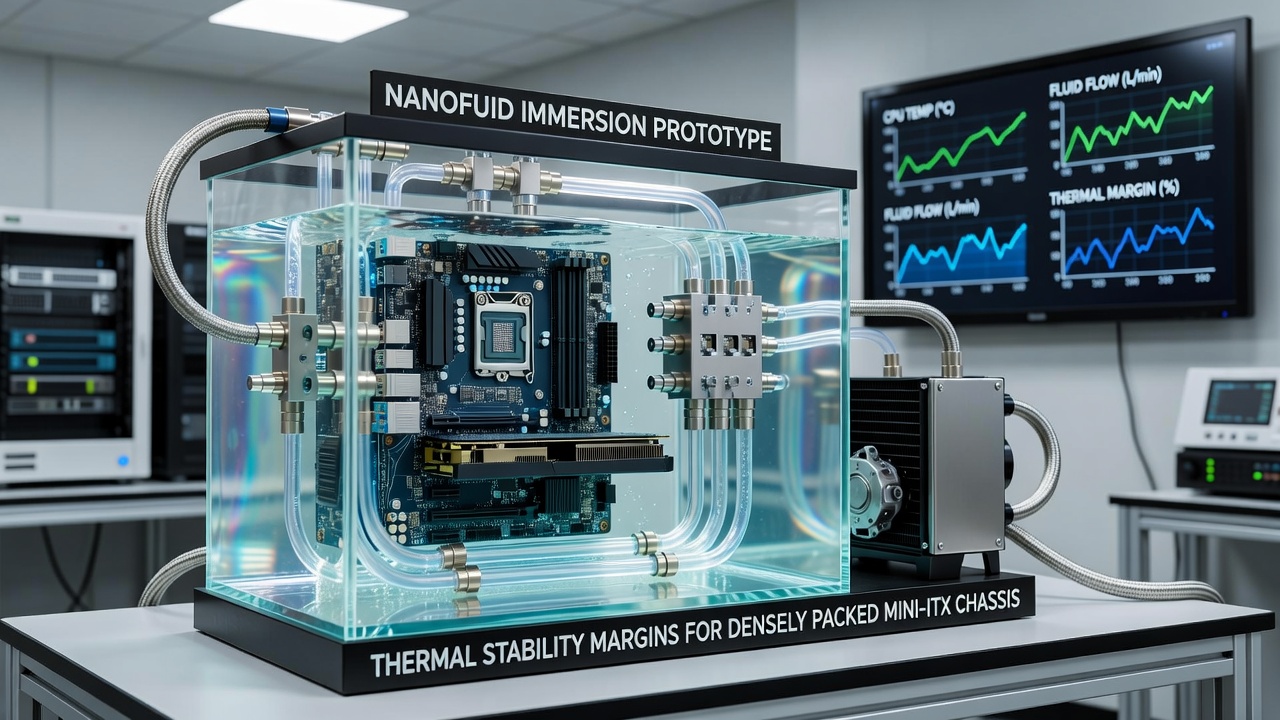
Compatibility testing covers seals, pumps, and tubing materials to prevent degradation over hundreds of hours. Evidence from accelerated aging trials indicates that properly formulated nanofluids maintain performance characteristics after 2,000 hours of continuous operation when filtration systems remove any agglomerated particles.
Performance Data from Sustained Sessions
Independent test facilities have recorded frame-time consistency in titles that combine ray tracing with large-scale multiplayer environments. Systems using nanofluid prototypes sustained clock speeds within 2 percent of maximum for sessions exceeding four hours, whereas air-cooled equivalents exhibited progressive downclocking after ninety minutes. Power delivery circuitry in the same chassis showed voltage ripple remaining below manufacturer thresholds throughout the test intervals.
Thermal imaging captured during these runs demonstrates reduced hot-spot formation around VRMs and memory, which correlates with fewer reported game disconnects attributed to hardware instability. Figures released by the National Institute of Standards and Technology highlight repeatable margins in thermal headroom across multiple chassis layouts.
Integration Considerations for Existing Hardware
Builders adapting these prototypes must verify pump reliability, reservoir capacity, and leak-detection sensors before deployment in competitive environments. Manufacturers have begun offering modular cold-plate kits sized for common Mini-ITX footprints, and early adopters report straightforward installation when following published torque specifications for mounting hardware. European research consortia have published guidelines that emphasize dielectric strength testing of candidate fluids to ensure electrical isolation around high-voltage components.
Maintenance intervals center on fluid analysis and filter replacement rather than traditional dust cleaning, which shifts service routines toward laboratory-style checks performed quarterly in high-use scenarios.
Conclusion
Current prototype evaluations establish that nanofluid immersion approaches deliver quantifiable thermal stability advantages inside constrained Mini-ITX volumes during prolonged ray-traced multiplayer workloads. Data collected through mid-2026 continue to refine fluid compositions and flow geometries, while hardware vendors evaluate pathways for broader availability. Those following the field can track forthcoming reports from standards organizations and academic groups that monitor long-term reliability metrics.