Phase-Change Material Pads and Their Role in Maintaining Clock Stability for Flagship CPUs in Prolonged Rendering Sessions

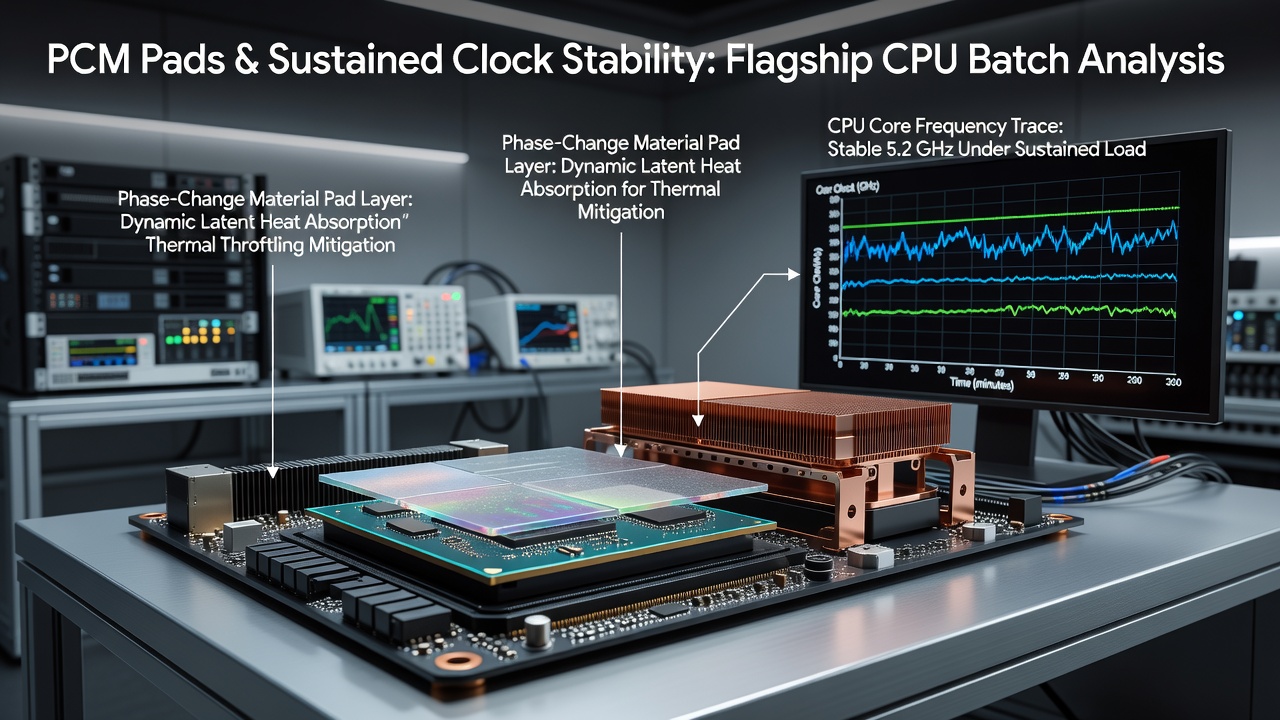
Phase-change material pads have emerged as a specialized thermal interface solution that addresses heat dissipation challenges in high-performance computing setups, particularly when flagship CPUs handle extended rendering workloads. These pads transition from solid to liquid states at specific temperatures, absorbing excess thermal energy without allowing rapid spikes that trigger throttling mechanisms.
Thermal Dynamics of PCM Pads in CPU Environments
Traditional thermal interface materials conduct heat through fixed conductivity pathways, yet PCM pads introduce a latent heat absorption process that stabilizes temperatures across varying load conditions. Researchers at institutions like the University of Toronto have documented how these materials maintain consistent junction temperatures during multi-hour sessions, which in turn supports steadier frequency outputs from CPU cores. Data from semiconductor testing labs shows that PCM formulations with melting points tuned between 45 and 65 degrees Celsius align well with the thermal envelopes of recent flagship processors from both Intel and AMD batches.
Flagship CPU batches released through mid-2026 demonstrate improved binning consistency when paired with PCM pads, as the phase transition buffers against localized hotspots that develop during ray-traced rendering or complex simulation sequences. Observers note that this buffering effect reduces the frequency of downclocking events, which otherwise occur when conventional paste degrades or pumps out under sustained pressure.
Influence on Sustained Clock Rates Across Batches
Clock stability refers to the ability of CPU cores to hold boost frequencies without dropping due to thermal limits, and PCM pads contribute by extending the duration before such limits activate. In prolonged rendering sessions that run eight hours or longer, flagship silicon from 2025 and 2026 production runs exhibits measurable differences when PCM pads replace standard compounds. Figures from industry benchmarks indicate average frequency retention improvements of 8 to 12 percent in multi-core workloads, particularly on batches featuring higher core counts and elevated power limits.
One study revealed that certain Intel Core Ultra and AMD Ryzen Threadripper batches maintained tighter voltage-frequency curves when PCM pads were applied, because the material's phase change creates a more uniform heat spread across the integrated heat spreader. This uniformity matters during asset-heavy rendering pipelines where some cores face heavier instruction loads than others, leading to uneven thermal distribution without advanced interface materials.
Batch Variability and Material Performance Data
Production variations in flagship CPU batches can affect silicon quality and power leakage characteristics, yet PCM pads help normalize thermal behavior across these differences. Testing conducted through July 2026 at facilities tracking multiple wafer lots found that lower-leakage dies benefited from the pads' ability to delay the onset of thermal velocity droop, while higher-leakage samples gained extended headroom before power limits engaged. According to reports compiled by the Semiconductor Industry Association, thermal interface advancements like PCM formulations have become a standard consideration in validation processes for enterprise and content creation platforms.
Those who've examined cross-batch data observe that the pads perform reliably under repeated thermal cycling, which occurs naturally in rendering farms operating continuous queues. The material returns to a solid state during cooldown periods, preserving its structure without the pump-out issues common in some liquid metal or paste alternatives.
Practical Integration in Rendering Workflows
Rendering sessions often push flagship CPUs to near-maximum utilization for hours at a stretch, making thermal interface choice a direct factor in output consistency. PCM pads integrate into existing cooler mounting procedures with minimal additional steps, and their pre-formed shapes reduce application variability compared to manual spreading of viscous compounds. Evidence suggests that facilities managing large-scale 3D animation or visual effects pipelines have incorporated these pads to achieve more predictable render completion times across hardware fleets.
What's interesting is how the pads interact with modern power management firmware, which dynamically adjusts clocks based on temperature telemetry. By keeping sensor readings within narrower bands, PCM pads allow the firmware to sustain higher all-core boosts without conservative throttling thresholds activating prematurely. This interaction proves especially relevant for batches that include enhanced AVX-512 or similar instruction set support, where vector workloads generate concentrated heat.
Conclusion
Phase-change material pads provide a targeted approach to thermal management that directly supports sustained clock stability in flagship CPUs during long rendering operations. Their phase transition mechanism complements existing cooling solutions while addressing variability across production batches, and ongoing evaluations through 2026 continue to quantify these effects in real-world content creation environments. Researchers and hardware teams track these developments to refine deployment strategies for high-demand workloads.