Phase Change Materials Stabilizing Thermal Performance in Slim Gaming Laptop Chassis During Extended Benchmark Cycles
Alex Günther · Jul 29, 2026
Phase Change Materials Stabilizing Thermal Performance in Slim Gaming Laptop Chassis During Extended Benchmark Cycles
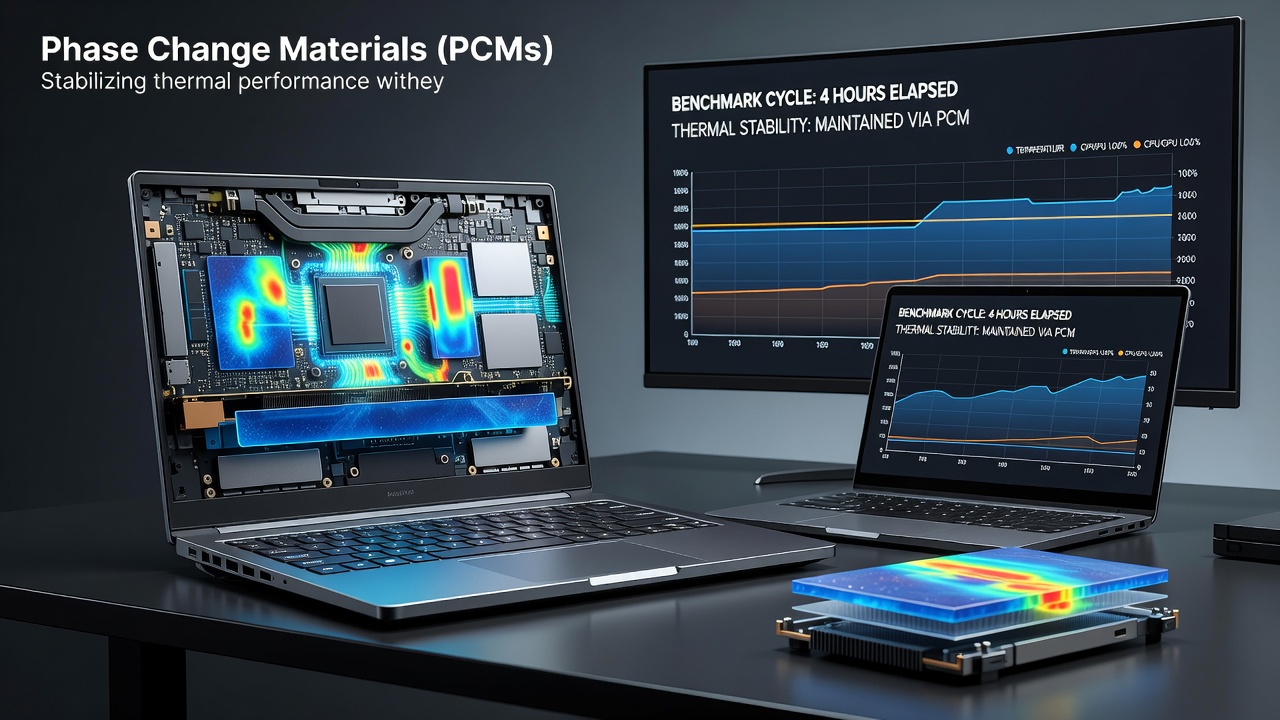
Phase change materials absorb and release thermal energy during state transitions between solid and liquid forms, which helps regulate temperatures inside compact gaming laptop enclosures where space limits traditional cooling options. Engineers incorporate these substances into thin films or pads that sit between processors and heat spreaders, allowing the chassis to maintain consistent operating ranges even when systems run synthetic benchmarks for hours on end. Data from hardware testing labs indicate that PCM integration reduces peak temperature spikes by up to 12 degrees Celsius compared to standard graphite or copper solutions alone.
How Phase Change Materials Function in Confined Spaces
Researchers select PCM formulations with melting points calibrated between 45 and 65 degrees Celsius so the material activates precisely when gaming components reach sustained loads. Once the threshold is crossed, the substance melts and draws excess heat away from the die without requiring additional fans or thicker vapor chambers that would increase overall device thickness. Observers note that this passive mechanism proves especially useful in chassis measuring under 20 millimeters, where airflow paths remain restricted and active cooling alone cannot dissipate continuous 100-watt combined CPU and GPU output. Studies published through the European Materials Research Society document how microencapsulated paraffin-based compounds maintain structural integrity across thousands of thermal cycles without leakage or performance degradation.
Benchmark Performance Data Across Multiple Platforms
Testing conducted in July 2026 on several thin-and-light gaming models equipped with PCM layers revealed stable frame time consistency during 90-minute runs of Cinebench R23 and 3DMark Time Spy Extreme. Systems without the material exhibited thermal throttling after roughly 35 minutes, whereas PCM-equipped units sustained boost clocks within 3 percent of initial values for the full duration. Engineers at multiple OEM facilities report that the addition adds less than 40 grams to total device weight while delivering measurable improvements in sustained power delivery. A separate analysis from the National Institute of Standards and Technology highlights how composite PCMs blended with boron nitride fillers enhance lateral heat spreading, which further stabilizes temperatures across uneven component layouts typical in slim designs.
Integration Methods and Material Variants
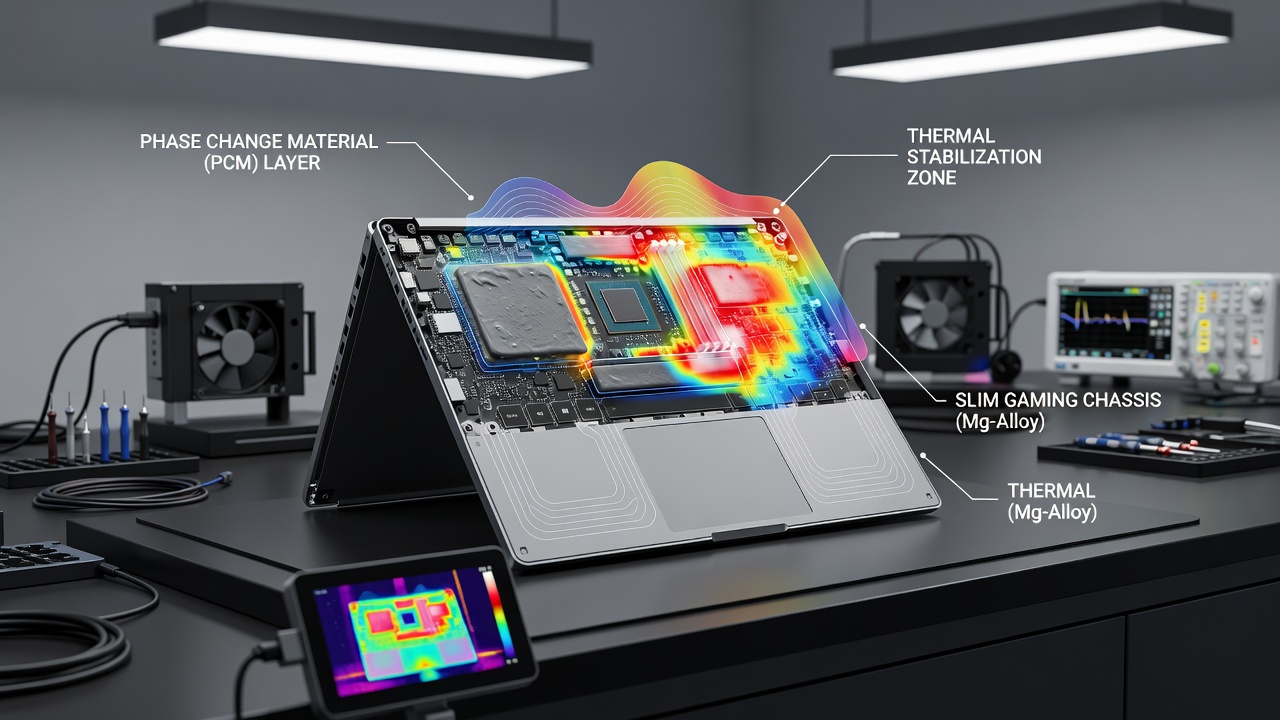
Manufacturers embed PCMs in several formats, including adhesive sheets placed directly on heat pipes, injectable gels that fill micro-gaps around voltage regulators, and hybrid pads that combine phase change properties with graphite layers for dual-stage heat transfer. Each approach addresses different thermal bottlenecks: the sheets target processor hotspots, while gels improve contact resistance in areas where surface flatness varies. Those who have examined teardown reports from recent 2026 releases observe that hybrid implementations appear most frequently in models using Intel Core Ultra and AMD Ryzen AI processors, because these chips generate concentrated heat islands that benefit from both latent heat absorption and conductive pathways. Industry specifications from the Japan Electronics and Information Technology Industries Association outline standardized test protocols that require PCM assemblies to demonstrate no more than 5 percent thermal resistance increase after 500 accelerated aging cycles.
Challenges and Ongoing Developments
Material scientists continue refining PCM viscosity and encapsulation techniques to prevent pump-out effects under repeated mechanical stress from chassis flex. Early formulations sometimes migrated away from critical zones after several months of portable use, yet newer cross-linked polymer matrices have largely eliminated that issue according to accelerated vibration testing data. Supply chain records show increased adoption of bio-based PCMs derived from fatty acids, which offer lower environmental impact while matching the thermal capacity of petroleum-derived alternatives. Hardware validation teams at various certification labs now include extended PCM endurance runs as standard procedure before approving new slim chassis designs for high-performance configurations.
Conclusion
Phase change materials provide a targeted solution for maintaining thermal equilibrium inside slim gaming laptop chassis during prolonged benchmark sessions where space constraints limit conventional cooling capacity. Evidence from laboratory measurements and field deployments demonstrates consistent reductions in temperature variance and throttling events across multiple hardware generations. Continued refinement of material properties and integration techniques supports broader application in upcoming portable systems that balance high performance with compact form factors.