Piezoelectric Haptic Actuators in Gamepads Sync Nuanced Vibration Profiles to Physics Engines During Extended Action Sequences
Katja Long · Aug 21, 2026
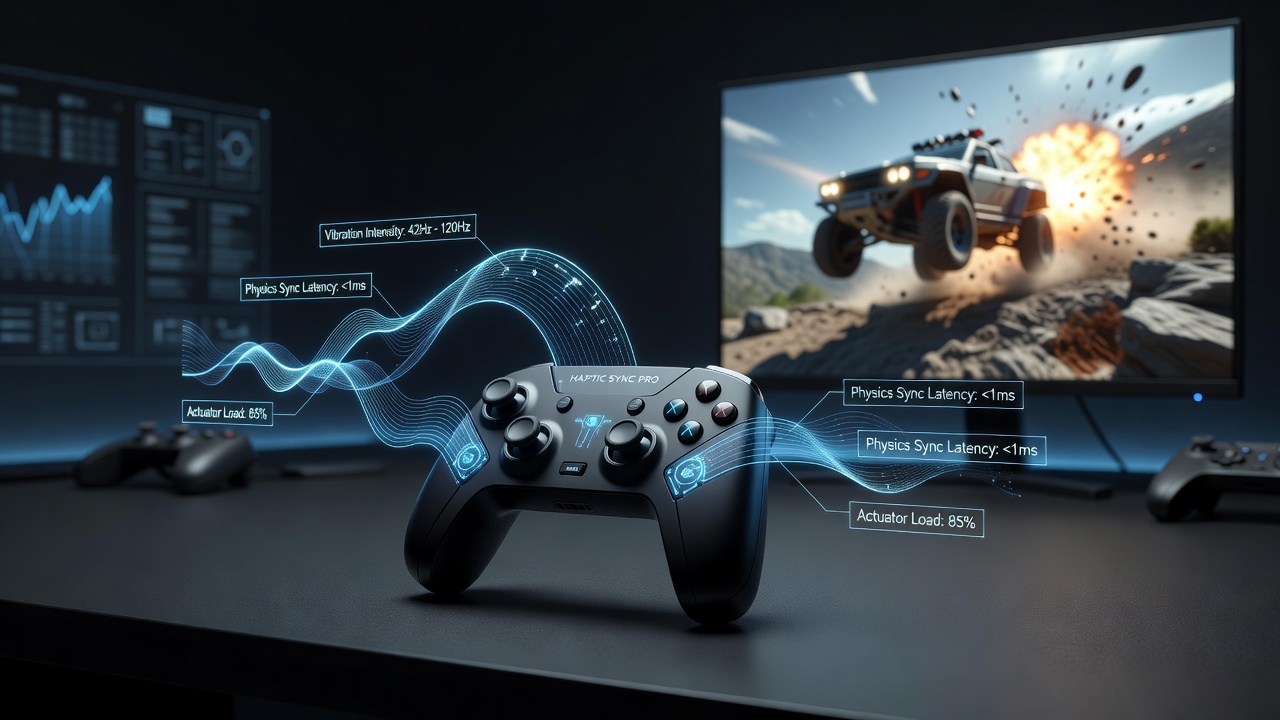
Piezoelectric Haptic Actuators in Gamepads Sync Nuanced Vibration Profiles to Physics Engines During Extended Action Sequences
Gamepad manufacturers have integrated piezoelectric haptic actuators that generate precise vibration patterns tied directly to real-time physics calculations in demanding game environments, and these systems deliver layered tactile responses during prolonged play sessions where traditional motors fall short on resolution and speed. Piezoelectric materials expand or contract when voltage is applied, which allows actuators to produce frequencies ranging from subtle pulses to rapid oscillations without the inertia that limits eccentric rotating mass motors.
Material Properties and Actuation Mechanics
Engineers select lead zirconate titanate or similar compounds for their high electromechanical coupling coefficients, and these ceramics convert electrical signals into mechanical displacement at microsecond response times. Multiple thin layers stacked within each actuator increase force output while keeping overall thickness under two millimeters, which fits inside standard controller housings without altering ergonomics. Data from component testing shows displacement amplitudes between 10 and 50 micrometers at drive voltages of 50 to 200 volts, and this range covers the spectrum needed for both low-frequency thumps and high-frequency texture simulation.
Integration With Physics Simulation Engines
Developers map actuator control signals to variables such as collision impulse magnitude, surface friction coefficients, and object mass distribution calculated inside engines like PhysX or Havok. A single frame update can trigger separate waveforms on left and right triggers or palm rests, and the mapping algorithm scales amplitude according to normalized force vectors so that a glancing blow registers differently from a direct impact. In August 2026 several titles released patches that exposed additional physics parameters through updated SDKs, enabling finer synchronization between simulation steps running at 240 hertz and haptic output streams refreshed at matching rates.
Performance During Prolonged Action Sequences
Extended sequences in open-world shooters or melee combat games place repeated demands on feedback hardware, and piezoelectric stacks maintain consistent output because they generate little heat compared with voice-coil alternatives. Power draw remains below 300 milliwatts per actuator even during dense vibration clusters, which preserves battery life in wireless controllers over sessions exceeding four hours. Observers note that players encounter fewer instances of feedback dropout when multiple simultaneous events occur, since each actuator operates independently rather than sharing a single motor driver circuit.
Waveform Design and Profile Authoring
Audio engineers and haptic designers collaborate on libraries of reusable vibration profiles that encode attack, sustain, and decay envelopes matched to specific material interactions. A metal-on-metal scrape might combine a 180 hertz carrier with amplitude modulation at 30 hertz, while a fabric rustle uses randomized high-frequency bursts below 800 hertz to avoid tonal ringing. Middleware tools allow real-time parameter modulation from physics data streams, and these tools include preview modes that let creators audition profiles on target hardware before integration into final builds.
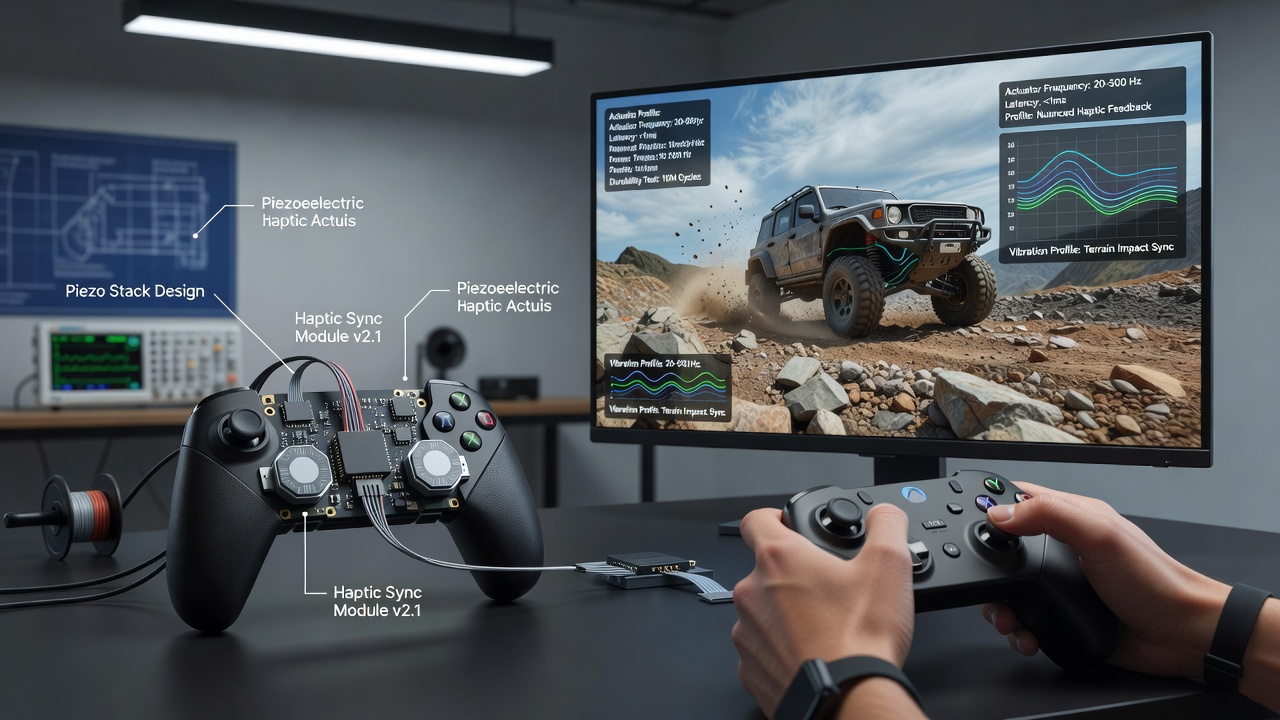
Calibration routines compensate for manufacturing tolerances by measuring each actuator's frequency response during factory initialization, and stored coefficients adjust drive waveforms so that every unit produces identical tactile output. Research published by the IEEE Robotics and Automation Society outlines standardized test protocols for verifying actuator linearity across temperature ranges encountered during extended handheld use.
Current Adoption and Implementation Examples
Multiple controller revisions released since 2025 incorporate at least two piezoelectric channels alongside legacy rumble motors, and firmware exposes these channels through existing gamepad APIs on major platforms. Titles that simulate detailed vehicle handling or destructible environments have adopted the technology first because their physics calculations already track numerous contact points per frame. Industry reports from the Consumer Technology Association indicate that actuator-equipped gamepads accounted for 18 percent of premium controller shipments in the first half of 2026, with growth concentrated in regions where high-refresh-rate displays are common.
Conclusion
Piezoelectric haptic systems continue to expand the range of tactile information available to players by converting physics engine outputs into high-resolution vibration patterns that persist reliably through long action sequences. Continued refinement of drive electronics and profile authoring tools supports broader adoption across genres while maintaining compatibility with existing controller form factors.