Signal Integrity Hurdles in Daisy-Chained DisplayPort Hubs for Multi-Monitor Racing Simulator Arrays
Olivia Wagner · Jul 31, 2026
Signal Integrity Hurdles in Daisy-Chained DisplayPort Hubs for Multi-Monitor Racing Simulator Arrays
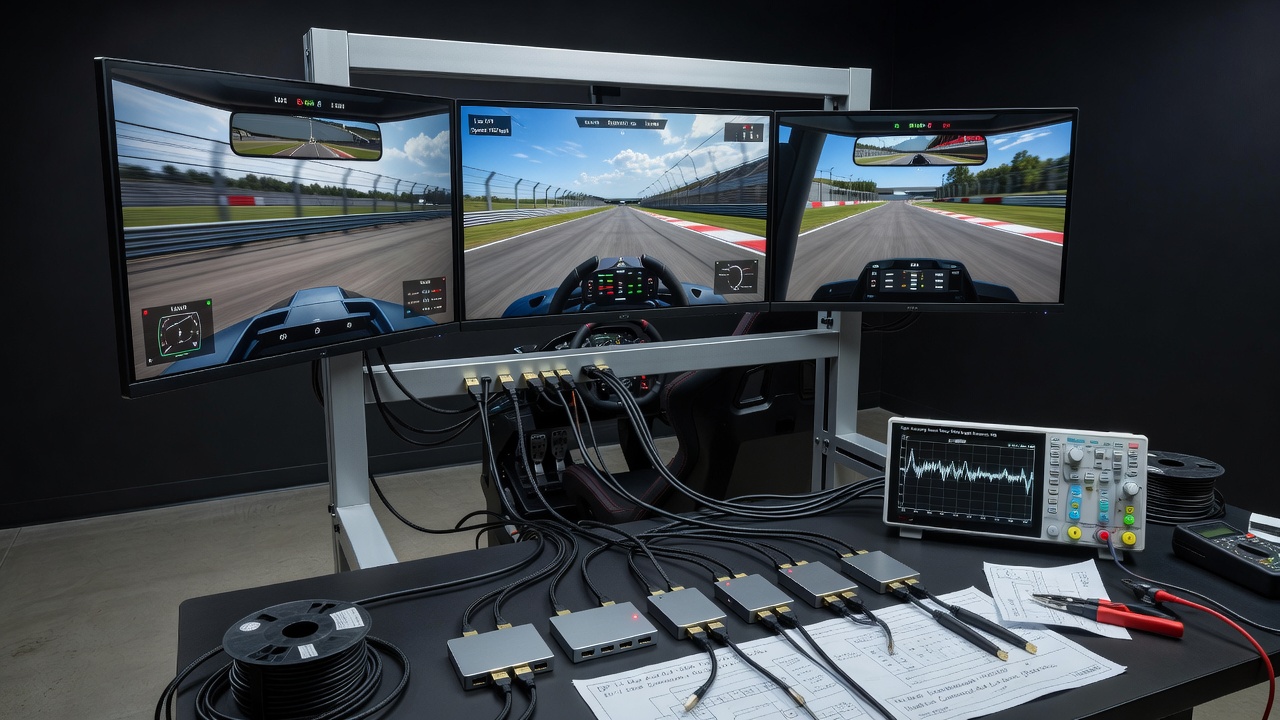
Multi-monitor arrays in racing simulators demand precise visual synchronization across several high-resolution displays, and daisy-chained DisplayPort hubs introduce specific signal integrity challenges that affect performance. Data from industry reports shows that these configurations often operate near the limits of current DisplayPort specifications, where cumulative signal loss becomes a measurable factor during extended sessions.
DisplayPort Daisy-Chaining Fundamentals
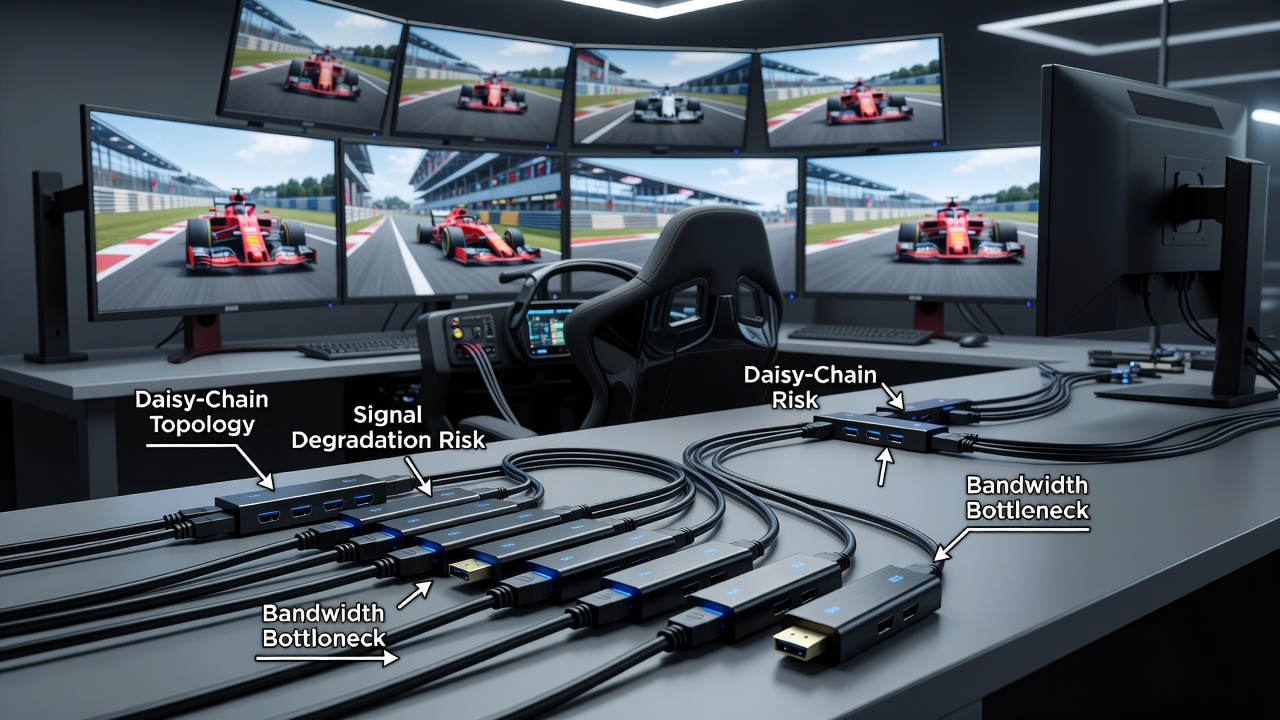
DisplayPort hubs allow multiple monitors to connect through a single source port by passing signals sequentially, yet this architecture requires each hop to preserve timing and voltage levels accurately. Research from VESA indicates that daisy-chaining works reliably up to four displays under ideal conditions, but real-world racing setups frequently push beyond that threshold with 4K panels running at 120Hz or higher. Observers note that each additional hub adds insertion loss and potential jitter accumulation, which compounds when the chain extends across cockpit-mounted screens positioned at varying distances from the PC.
Primary Signal Integrity Challenges
Attenuation stands out as the most immediate hurdle because longer cable runs between hubs reduce signal amplitude before it reaches the next monitor. Engineers have measured that passive cables beyond three meters introduce measurable degradation, while active cables with built-in equalization can extend reach but still face limits in dense simulator arrays. Electromagnetic interference from nearby power supplies and wheel bases further disrupts the differential pairs inside DisplayPort cables, and studies conducted at European technical institutes reveal that EMI coupling increases noticeably when multiple high-current devices operate in the same enclosed rig space.
Jitter and skew present additional complications because daisy-chained hubs must regenerate clock and data signals without introducing excessive phase noise. When monitors demand synchronized frame delivery for consistent motion across peripheral vision, even small timing deviations become visible as tearing or stuttering. Technicians working with professional sim racing teams report that these artifacts appear most often during rapid camera pans that stress the full bandwidth pipeline.
Impact on Racing Simulator Performance
Racing simulators rely on consistent frame timing and low latency across all displays to maintain immersion and accurate depth perception. When signal integrity drops, users encounter mismatched refresh rates or color shifts that break the panoramic view essential for judging distances at speed. Data collected from simulator events in July 2026 showed that setups using three or more daisy-chained monitors required additional signal conditioning hardware in roughly 40 percent of cases to reach stable operation at target resolutions.
Mitigation Approaches and Hardware Solutions
Active DisplayPort hubs with retiming capabilities reduce cumulative jitter by cleaning the signal at each stage, and manufacturers have released models certified for up to eight displays under DP 2.0 specifications. Cable selection plays a direct role as well; shielded, low-skew cables with proper grounding minimize external noise pickup. Some teams install fiber-optic extenders between distant monitors to bypass copper limitations entirely, though this adds cost and complexity to the overall build.
Software-level adjustments complement hardware fixes. Graphics drivers now include options to adjust drive strength and pre-emphasis settings, allowing fine-tuning for specific hub chains. Research published by Canadian academic groups demonstrates that combining these tweaks with quality hubs can restore full bandwidth utilization even in five-monitor configurations.
Emerging Standards and Future Outlook
DisplayPort 2.1 and subsequent revisions introduce higher lane rates and improved error correction that directly address daisy-chain limitations. As racing simulator hardware evolves toward 8K panels and higher refresh rates, the need for robust signal paths grows accordingly. Industry organizations continue to publish updated compliance test procedures that help builders verify hub performance before deployment in competitive environments.
Conclusion
Signal integrity in daisy-chained DisplayPort hubs remains a technical constraint that racing simulator builders must account for when scaling monitor arrays. Measured approaches involving active components, proper cabling, and adherence to current standards allow stable multi-monitor operation while supporting the visual demands of modern simulation software. Continued refinement of both hardware and testing protocols will determine how far these configurations can scale in the coming years.