Thermal Interface Material Formulations Counteracting Junction Temperature Spikes in Handheld PC Gaming During Prolonged Open-World Asset Rendering Cycles
Katja Long · Jul 22, 2026
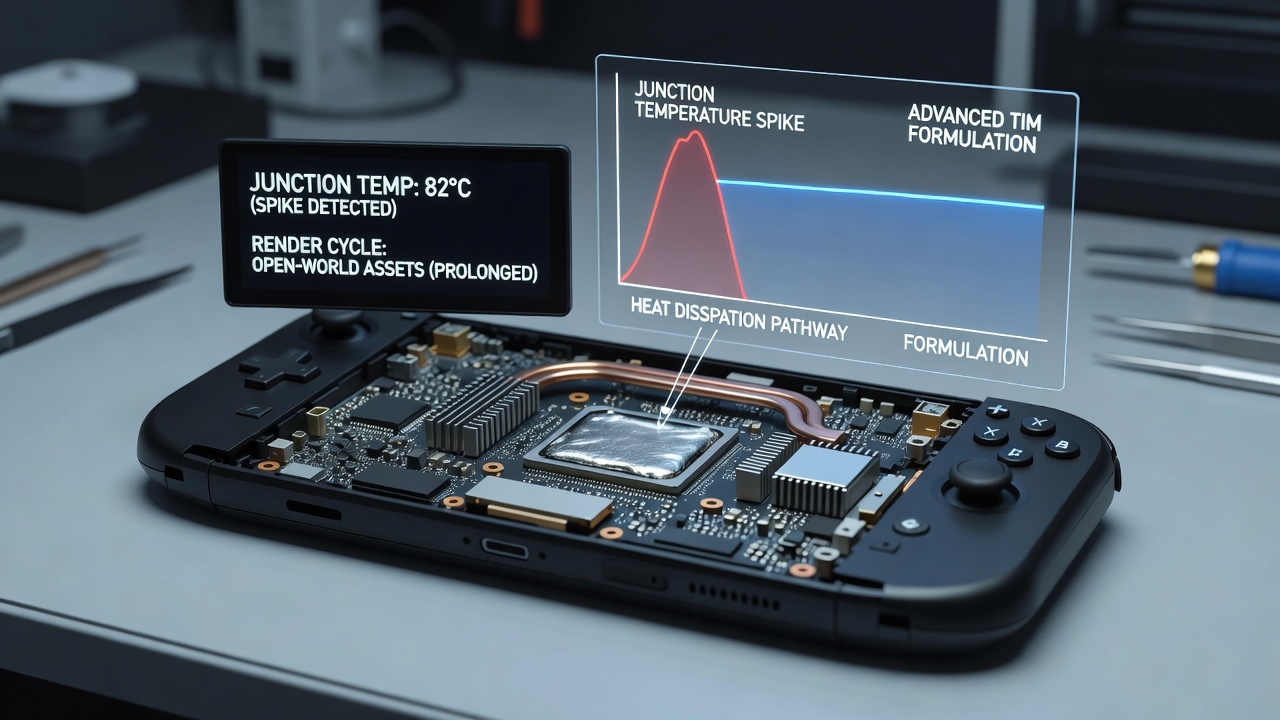
Thermal Interface Material Formulations Counteracting Junction Temperature Spikes in Handheld PC Gaming During Prolonged Open-World Asset Rendering Cycles
Handheld PC gaming devices face consistent thermal challenges when processing open-world titles that demand continuous asset rendering over extended periods, and thermal interface material formulations play a direct role in managing junction temperature spikes at the processor level. These materials fill microscopic gaps between heat-generating chips and cooling solutions, reducing thermal resistance that otherwise leads to performance throttling or hardware stress during long sessions.
Core Components in Modern TIM Formulations
Formulations typically combine base matrices such as silicone polymers or synthetic oils with conductive fillers including aluminum oxide, zinc oxide, boron nitride, and increasingly graphene or carbon nanotubes. Data from semiconductor thermal studies shows that filler particle size distribution and volume loading percentages determine the overall thermal conductivity, with optimized blends reaching values above 8 W/mK in commercial handheld applications. Phase-change materials integrated into some formulations transition from solid to liquid states at specific temperatures around 45 to 60 degrees Celsius, allowing adaptive contact under load without requiring constant pressure adjustments.
Manufacturers adjust these compositions to account for the mechanical constraints of compact chassis designs, where vibration from handheld use and repeated thermal cycling can degrade traditional pastes over time. Research indicates that hybrid formulations incorporating both ceramic particles and metallic micro-particles maintain stability across temperature ranges encountered during asset streaming sequences that keep GPUs at sustained high utilization.
Performance Under Extended Rendering Loads
Open-world games require ongoing texture loading and world simulation that push integrated graphics and CPUs to maintain frame consistency, resulting in junction temperatures that can climb rapidly without effective heat transfer paths. Thermal interface materials formulated for low thermal impedance help dissipate heat from die hotspots to vapor chambers or heat pipes before spikes exceed safe operating thresholds, typically keeping peaks below 95 degrees Celsius in devices tested under continuous loads. Observers note that formulations with reduced pump-out characteristics, achieved through higher viscosity bases and cross-linking agents, preserve performance across multi-hour sessions where repeated expansion and contraction would otherwise create air gaps.
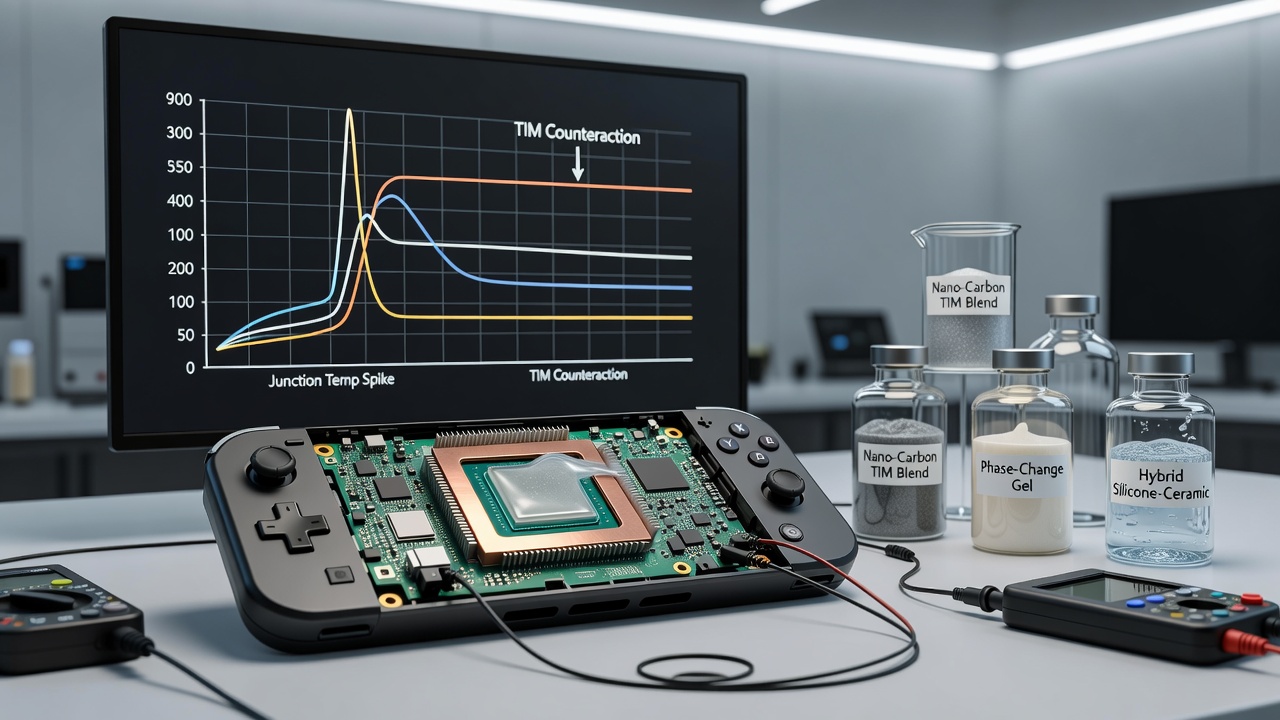
Testing protocols used by hardware developers measure temperature gradients across the interface layer under synthetic benchmarks that replicate asset rendering cycles, revealing that advanced TIMs can lower peak junction readings by 8 to 12 degrees Celsius compared with baseline materials. This margin becomes relevant in July 2026 as new handheld models incorporate higher TDP configurations for enhanced graphical fidelity, where even small reductions in thermal buildup support longer sustained operation without frequency scaling.
Material Selection and Application Techniques
Engineers evaluate TIM options based on metrics such as bond line thickness, compression force requirements, and long-term reliability under humidity and temperature cycling conditions specified in industry standards. Automated dispensing systems apply precise volumes of paste or pad materials during production to ensure uniform coverage over irregular die surfaces common in system-on-chip designs used in portable gaming hardware. Liquid metal alloys, while offering superior conductivity in some stationary builds, require additional containment measures in handhelds to prevent migration that could affect electrical components during movement.
Studies conducted at research institutions across multiple regions document how particle agglomeration in older formulations leads to increased thermal resistance after 500 hours of operation, prompting shifts toward stabilized nanoparticle dispersions that resist settling. These refinements directly address the demands of prolonged open-world rendering where continuous high-power draw maintains elevated temperatures for hours at a stretch.
Integration with Device Cooling Architectures
Handheld platforms combine TIM layers with active and passive cooling elements, including small fans, heat spreaders, and sometimes external dock-assisted solutions. Formulations optimized for these stacked assemblies minimize interface resistance at multiple contact points, allowing heat to flow efficiently from the processor package through the TIM to the primary cooling structure. Data collected from endurance tests shows consistent frame delivery metrics when thermal interface performance prevents throttling events that would otherwise interrupt asset loading pipelines.
Supply chain reports highlight increased adoption of pre-applied TIM pads in modular repair programs, reducing variability introduced by field reapplication while maintaining the thermal performance needed for demanding game environments. Such approaches support device longevity as users engage in extended play sessions across different ambient conditions.
Conclusion
Thermal interface material formulations continue to evolve in response to the specific thermal profiles generated by handheld PC gaming hardware during extended open-world asset rendering. Through targeted adjustments in composition, application methods, and compatibility with compact cooling systems, these materials help maintain junction temperatures within operational limits across sustained workloads. Ongoing material science developments provide measurable improvements in heat transfer efficiency that align with the performance requirements of current and upcoming portable gaming platforms.